
The story of Paul's stormy voyage is reminiscent of the voyage of Jonah. The prophet also encountered a violent storm at sea. Jonah's crew also jettisoned the cargo and began to despair of life. And the crew and passengers of Jonah's ship were ultimately delivered. There is, of course, a major difference between the two. It was Jonah's presence on the ship that gave rise to the storm, and only in his absence were the others saved. It was altogether different for Paul's ship. The apostle's presence on the ship led to the deliverance of all aboard. (522)The story itself is one of salvation as Luke uses the Greek word for "save" at key moments of the story. The crew and all those on board were in desperate need of deliverance. It is a fitting picture of the spiritual state of the unredeemed. Unable to deliver ourselves, we need salvation.
Showing posts with label Jonah. Show all posts
Showing posts with label Jonah. Show all posts
Wednesday, December 4, 2013
Remember Jonah?: A Great Nugget from Acts 27
Earlier this year we studied the the book of Jonah. This afternoon while preparing for tonight's Bible study, I came across the following paragraph in Dr. John Polhill's commentary on Acts regarding Paul's shipwreck at the end of Acts.

Wednesday, May 22, 2013
Jonah: Salvation is From the Lord Sermon Series
We have finished yet another sermon series this time on the wonderful book of Jonah. Below are the links to all of the sermon/sermon notes as well as all of the articles and other resources.
Sermons
April 7, 2013 | Jonah 1:1-3 - You Can Run But Not Hide: Why That is Really Good News
April 14, 2013 | Jonah 1:4-17 - Grace Goes Both Ways You Know: Why that is Really Really Good News
April 21, 2013 | Jonah 2:1-10 - Salvation is From the Lord: Why I Stand Amazed & Not Condemned
May 5, 2013 | Jonah 3:1-10 - Some Things Never Change: Divine Stubbornness & Why Grace is Unconditional
May 19, 2013 | Jonah 4:1-11 - Should I Not Have Compassion?
Articles
How Are We to Understand Jonah: As Historical?
How Are We to Understand Jonah: As Midrash?
How Are We to Understand Jonah: As Allegorical?
Holman Dictionary on Jonah
Bibledex on Jonah
VeggieTales and Jonah
Man Swallowed By Hippo & Lived to Tell About It
Other Series
Faith in the Midst of God-Ordained Storms Sermon Series
God: Proper Theology Proper Sermon Series
The Sermon on the Mount Series
Matthew Thus Far: Matthew 1-5
Matthew 8-12 - The King Has Come: The Gospel According to Matthew Series
The Last Week of Jesus: From Triumphal Entry to Triumphal Grave Series
Fruitie-Tales: Living By the Fruit of the Spirit
Basic Christianity Series
Revelation Study
Sermons
April 7, 2013 | Jonah 1:1-3 - You Can Run But Not Hide: Why That is Really Good News
April 14, 2013 | Jonah 1:4-17 - Grace Goes Both Ways You Know: Why that is Really Really Good News
April 21, 2013 | Jonah 2:1-10 - Salvation is From the Lord: Why I Stand Amazed & Not Condemned
May 5, 2013 | Jonah 3:1-10 - Some Things Never Change: Divine Stubbornness & Why Grace is Unconditional
May 19, 2013 | Jonah 4:1-11 - Should I Not Have Compassion?
Articles
How Are We to Understand Jonah: As Historical?
How Are We to Understand Jonah: As Midrash?
How Are We to Understand Jonah: As Allegorical?
Holman Dictionary on Jonah
Bibledex on Jonah
VeggieTales and Jonah
Man Swallowed By Hippo & Lived to Tell About It
Other Series
Faith in the Midst of God-Ordained Storms Sermon Series
God: Proper Theology Proper Sermon Series
The Sermon on the Mount Series
Matthew Thus Far: Matthew 1-5
Matthew 8-12 - The King Has Come: The Gospel According to Matthew Series
The Last Week of Jesus: From Triumphal Entry to Triumphal Grave Series
Fruitie-Tales: Living By the Fruit of the Spirit
Basic Christianity Series
Revelation Study
Wednesday, May 8, 2013
May 5, 2013 | Jonah 3:1-10 - Some Things Never Change: Divine Stubbornness & Why Grace is Unconditional
Here is part four of five of our sermon series on the wonderful Book of Jonah.
Now the word of the Lord came to Jonah the second time, saying, 2 “Arise, go to Nineveh the great city and proclaim to it the proclamation which I am going to tell you.” 3 So Jonah arose and went to Nineveh according to the word of the Lord. Now Nineveh was an exceedingly great city, a three days’ walk. 4 Then Jonah began to go through the city one day’s walk; and he cried out and said, “Yet forty days and Nineveh will be overthrown.”
5 Then the people of Nineveh believed in God; and they called a fast and put on sackcloth from the greatest to the least of them. 6 When the word reached the king of Nineveh, he arose from his throne, laid aside his robe from him, covered himself with sackcloth and sat on the ashes. 7 He issued a proclamation and it said, “In Nineveh by the decree of the king and his nobles: Do not let man, beast, herd, or flock taste a thing. Do not let them eat or drink water. 8 But both man and beast must be covered with sackcloth; and let men call on God earnestly that each may turn from his wicked way and from the violence which is in his hands. 9 Who knows, God may turn and relent and withdraw His burning anger so that we will not perish.”
10 When God saw their deeds, that they turned from their wicked way, then God relented concerning the calamity which He had declared He would bring upon them. And He did not do it.
Audio
Notes
April 7, 2013 | Jonah 1:1-3 - You Can Run But Not Hide: Why That is Really Good News
April 14, 2013 | Jonah 1:4-17 - Grace Goes Both Ways You Know: Why that is Really Really Good News
April 21, 2013 | Jonah 2:1-10 - Salvation is From the Lord: Why I Stand Amazed & Not Condemned
May 5, 2013 | Jonah 3:1-10 - Some Things Never Change: Divine Stubbornness & Why Grace is Unconditional
For more:
How Are We to Understand Jonah: As Historical?
How Are We to Understand Jonah: As Midrash?
How Are We to Understand Jonah: As Allegorical?
Holman Dictionary on Jonah
Bibledex on Jonah
VeggieTales and Jonah
Man Swallowed By Hippo & Lived to Tell About It
Now the word of the Lord came to Jonah the second time, saying, 2 “Arise, go to Nineveh the great city and proclaim to it the proclamation which I am going to tell you.” 3 So Jonah arose and went to Nineveh according to the word of the Lord. Now Nineveh was an exceedingly great city, a three days’ walk. 4 Then Jonah began to go through the city one day’s walk; and he cried out and said, “Yet forty days and Nineveh will be overthrown.”
5 Then the people of Nineveh believed in God; and they called a fast and put on sackcloth from the greatest to the least of them. 6 When the word reached the king of Nineveh, he arose from his throne, laid aside his robe from him, covered himself with sackcloth and sat on the ashes. 7 He issued a proclamation and it said, “In Nineveh by the decree of the king and his nobles: Do not let man, beast, herd, or flock taste a thing. Do not let them eat or drink water. 8 But both man and beast must be covered with sackcloth; and let men call on God earnestly that each may turn from his wicked way and from the violence which is in his hands. 9 Who knows, God may turn and relent and withdraw His burning anger so that we will not perish.”
10 When God saw their deeds, that they turned from their wicked way, then God relented concerning the calamity which He had declared He would bring upon them. And He did not do it.
Audio
Notes
April 7, 2013 | Jonah 1:1-3 - You Can Run But Not Hide: Why That is Really Good News
April 14, 2013 | Jonah 1:4-17 - Grace Goes Both Ways You Know: Why that is Really Really Good News
April 21, 2013 | Jonah 2:1-10 - Salvation is From the Lord: Why I Stand Amazed & Not Condemned
May 5, 2013 | Jonah 3:1-10 - Some Things Never Change: Divine Stubbornness & Why Grace is Unconditional
For more:
How Are We to Understand Jonah: As Historical?
How Are We to Understand Jonah: As Midrash?
How Are We to Understand Jonah: As Allegorical?
Holman Dictionary on Jonah
Bibledex on Jonah
VeggieTales and Jonah
Man Swallowed By Hippo & Lived to Tell About It
Tuesday, May 7, 2013
Man Swallowed By Hippo & Lived to Tell About It
In light of our current study of Jonah, I thought the following story was worth retelling:
In a story that sounds like it came straight from the Bible—or Pinocchio—Paul Templer claims he was swallowed by a hippo while leading a kayak tour down the Zambezi River. The hippo attack happened 17 years ago, but this week Templer recounted the horrifying tale to The Guardian.
Templer was a 27-year old river guide who had lead tours down the Zambezi many times and had weathered several of what he considered “half-hearted attacks” by a certain territorial male hippo. . . .
In a story that sounds like it came straight from the Bible—or Pinocchio—Paul Templer claims he was swallowed by a hippo while leading a kayak tour down the Zambezi River. The hippo attack happened 17 years ago, but this week Templer recounted the horrifying tale to The Guardian.
Templer was a 27-year old river guide who had lead tours down the Zambezi many times and had weathered several of what he considered “half-hearted attacks” by a certain territorial male hippo. . . .
Tuesday, April 23, 2013
April 21, 2013 | Jonah 2:1-10 - Salvation is From the Lord: Why I Stand Amazed
The third part of our verse-by-verse exposition of Jonah.
Then Jonah prayed to the Lord his God from the stomach of the fish, 2 and he said,
10 Then the Lord commanded the fish, and it vomited Jonah up onto the dry land.
Audio
Notes
April 7, 2013 | Jonah 1:1-3 - You Can Run But Not Hide: Why That is Really Good News
April 14, 2013 | Jonah 1:4-17 - Grace Goes Both Ways You Know: Why that is Really Really Good News
April 21, 2013 | Jonah 2:1-10 - Salvation is From the Lord: Why I Stand Amazed
For more:
Simul justus et peccator: Luther & the Heart of the Gospel
I Hear You: A Sermon Illustration
How Are We to Understand Jonah: As Historical?
How Are We to Understand Jonah: As Midrash?
How Are We to Understand Jonah: As Allegorical?
Holman Dictionary on Jonah
Bibledex on Jonah
VeggieTales and Jonah
Then Jonah prayed to the Lord his God from the stomach of the fish, 2 and he said,
“I called out of my distress to the Lord,
And He answered me.
I cried for help from the depth of Sheol;
You heard my voice.
3 “For You had cast me into the deep,
Into the heart of the seas,
And the current engulfed me.
All Your breakers and billows passed over me.
4 “So I said, ‘I have been expelled from Your sight.
Nevertheless I will look again toward Your holy temple.’
5 “Water encompassed me to the point of death.
The great deep engulfed me,
Weeds were wrapped around my head.
6 “I descended to the roots of the mountains.
The earth with its bars was around me forever,
But You have brought up my life from the pit, O Lord my God.
7 “While I was fainting away,
I remembered the Lord,
And my prayer came to You,
Into Your holy temple.
8 “Those who regard vain idols
Forsake their faithfulness,
9 But I will sacrifice to You
With the voice of thanksgiving.
That which I have vowed I will pay.
Salvation is from the Lord.”
And He answered me.
I cried for help from the depth of Sheol;
You heard my voice.
3 “For You had cast me into the deep,
Into the heart of the seas,
And the current engulfed me.
All Your breakers and billows passed over me.
4 “So I said, ‘I have been expelled from Your sight.
Nevertheless I will look again toward Your holy temple.’
5 “Water encompassed me to the point of death.
The great deep engulfed me,
Weeds were wrapped around my head.
6 “I descended to the roots of the mountains.
The earth with its bars was around me forever,
But You have brought up my life from the pit, O Lord my God.
7 “While I was fainting away,
I remembered the Lord,
And my prayer came to You,
Into Your holy temple.
8 “Those who regard vain idols
Forsake their faithfulness,
9 But I will sacrifice to You
With the voice of thanksgiving.
That which I have vowed I will pay.
Salvation is from the Lord.”
Audio
Notes
April 7, 2013 | Jonah 1:1-3 - You Can Run But Not Hide: Why That is Really Good News
April 14, 2013 | Jonah 1:4-17 - Grace Goes Both Ways You Know: Why that is Really Really Good News
April 21, 2013 | Jonah 2:1-10 - Salvation is From the Lord: Why I Stand Amazed
For more:
Simul justus et peccator: Luther & the Heart of the Gospel
I Hear You: A Sermon Illustration
How Are We to Understand Jonah: As Historical?
How Are We to Understand Jonah: As Midrash?
How Are We to Understand Jonah: As Allegorical?
Holman Dictionary on Jonah
Bibledex on Jonah
VeggieTales and Jonah
Monday, April 22, 2013
April 14, 2013 | Jonah 1:4-17 - Grace Goes Both Ways You Know: Why that is Really Really Good News
We continue our series on Jonah by examining verses 4-17 of chapter 1.
4 The Lord hurled a great wind on the sea and there was a great storm on the sea so that the ship was about to break up. 5 Then the sailors became afraid and every man cried to his god, and they threw the cargo which was in the ship into the sea to lighten it for them. But Jonah had gone below into the hold of the ship, lain down and fallen sound asleep. 6 So the captain approached him and said, “How is it that you are sleeping? Get up, call on your god. Perhaps your god will be concerned about us so that we will not perish.”
7 Each man said to his mate, “Come, let us cast lots so we may learn on whose account this calamity has struck us.” So they cast lots and the lot fell on Jonah. 8 Then they said to him, “Tell us, now! On whose account has this calamity struck us? What is your occupation? And where do you come from? What is your country? From what people are you?” 9 He said to them, “I am a Hebrew, and I fear the Lord God of heaven who made the sea and the dry land.”
10 Then the men became extremely frightened and they said to him, “How could you do this?” For the men knew that he was fleeing from the presence of the Lord, because he had told them. 11 So they said to him, “What should we do to you that the sea may become calm for us?”—for the sea was becoming increasingly stormy. 12 He said to them, “Pick me up and throw me into the sea. Then the sea will become calm for you, for I know that on account of me this great storm has come upon you.” 13 However, the men rowed desperately to return to land but they could not, for the sea was becoming even stormier against them. 14 Then they called on the Lord and said, “We earnestly pray, O Lord, do not let us perish on account of this man’s life and do not put innocent blood on us; for You, O Lord, have done as You have pleased.”
15 So they picked up Jonah, threw him into the sea, and the sea stopped its raging. 16 Then the men feared the Lord greatly, and they offered a sacrifice to the Lord and made vows.
17 And the Lord appointed a great fish to swallow Jonah, and Jonah was in the stomach of the fish three days and three nights.
Audio
Notes
April 7, 2013 | Jonah 1:1-3 - You Can Run But Not Hide: Why That is Really Good News
April 14, 2013 | Jonah 1:4-17 - Grace Goes Both Ways You Know: Why that is Really Really Good News
For more:
Simul justus et peccator: Luther & the Heart of the Gospel
I Hear You: A Sermon Illustration
How Are We to Understand Jonah: As Historical?
How Are We to Understand Jonah: As Midrash?
How Are We to Understand Jonah: As Allegorical?
Holman Dictionary on Jonah
Bibledex on Jonah
VeggieTales and Jonah
4 The Lord hurled a great wind on the sea and there was a great storm on the sea so that the ship was about to break up. 5 Then the sailors became afraid and every man cried to his god, and they threw the cargo which was in the ship into the sea to lighten it for them. But Jonah had gone below into the hold of the ship, lain down and fallen sound asleep. 6 So the captain approached him and said, “How is it that you are sleeping? Get up, call on your god. Perhaps your god will be concerned about us so that we will not perish.”
7 Each man said to his mate, “Come, let us cast lots so we may learn on whose account this calamity has struck us.” So they cast lots and the lot fell on Jonah. 8 Then they said to him, “Tell us, now! On whose account has this calamity struck us? What is your occupation? And where do you come from? What is your country? From what people are you?” 9 He said to them, “I am a Hebrew, and I fear the Lord God of heaven who made the sea and the dry land.”
10 Then the men became extremely frightened and they said to him, “How could you do this?” For the men knew that he was fleeing from the presence of the Lord, because he had told them. 11 So they said to him, “What should we do to you that the sea may become calm for us?”—for the sea was becoming increasingly stormy. 12 He said to them, “Pick me up and throw me into the sea. Then the sea will become calm for you, for I know that on account of me this great storm has come upon you.” 13 However, the men rowed desperately to return to land but they could not, for the sea was becoming even stormier against them. 14 Then they called on the Lord and said, “We earnestly pray, O Lord, do not let us perish on account of this man’s life and do not put innocent blood on us; for You, O Lord, have done as You have pleased.”
15 So they picked up Jonah, threw him into the sea, and the sea stopped its raging. 16 Then the men feared the Lord greatly, and they offered a sacrifice to the Lord and made vows.
17 And the Lord appointed a great fish to swallow Jonah, and Jonah was in the stomach of the fish three days and three nights.
Audio
Notes
April 7, 2013 | Jonah 1:1-3 - You Can Run But Not Hide: Why That is Really Good News
April 14, 2013 | Jonah 1:4-17 - Grace Goes Both Ways You Know: Why that is Really Really Good News
For more:
Simul justus et peccator: Luther & the Heart of the Gospel
I Hear You: A Sermon Illustration
How Are We to Understand Jonah: As Historical?
How Are We to Understand Jonah: As Midrash?
How Are We to Understand Jonah: As Allegorical?
Holman Dictionary on Jonah
Bibledex on Jonah
VeggieTales and Jonah
Friday, April 19, 2013
Simul justus et peccator: Luther & the Heart of the Gospel
Sunday we will be examining Jonah 2 which is a psalm of thanksgiving and repentance. Jonah is a believer who has rebelled. Nonetheless, God's grace reaches him even at the bottom of the sea. This is good news. I am a firm believer in Jesus Christ and yet I find myself always failing. Though I seek the glory of Christ and daily fight to live a holy life, I find myself oftentimes losing. So what hope do I have?
The answer to this question is found in Martin Luther's coined phrase simul justus et peccator (that is, "Simultaneously righteous & a sinner). What Luther meant by that is explained by Dr. RC Sproul in the video below. In short, if you can understand this concept you can understand the gospel.
What Does "Simul Justus et Peccator" Mean? from Ligonier Ministries on Vimeo.
For more:
I Hear You: A Sermon Illustration
April 7, 2013 | John 1:1-3 - You Can Run But Not Hide: Why That is Really Good News
How Are We to Understand Jonah: As Historical?
How Are We to Understand Jonah: As Midrash?
How Are We to Understand Jonah: As Allegorical?
Holman Dictionary on Jonah
Bibledex on Jonah
VeggieTales and Jonah
The answer to this question is found in Martin Luther's coined phrase simul justus et peccator (that is, "Simultaneously righteous & a sinner). What Luther meant by that is explained by Dr. RC Sproul in the video below. In short, if you can understand this concept you can understand the gospel.
What Does "Simul Justus et Peccator" Mean? from Ligonier Ministries on Vimeo.
For more:
I Hear You: A Sermon Illustration
April 7, 2013 | John 1:1-3 - You Can Run But Not Hide: Why That is Really Good News
How Are We to Understand Jonah: As Historical?
How Are We to Understand Jonah: As Midrash?
How Are We to Understand Jonah: As Allegorical?
Holman Dictionary on Jonah
Bibledex on Jonah
VeggieTales and Jonah
Thursday, April 18, 2013
April 7, 2013 | John 1:1-3 - You Can Run But Not Hide: Why That is Really Good News
We have begun a new series walking verse-by-verse through the Book of Jonah. We begin by examining the first three verses with the important and precious truth, we can run but we cannot hide from God.
The word of the Lord came to Jonah the son of Amittai saying, 2 “Arise, go to Nineveh the great city and cry against it, for their wickedness has come up before Me.” 3 But Jonah rose up to flee to Tarshish from the presence of the Lord. So he went down to Joppa, found a ship which was going to Tarshish, paid the fare and went down into it to go with them to Tarshish from the presence of the Lord.
Audio
Notes
For more:
How Are We to Understand Jonah: As Historical?
How Are We to Understand Jonah: As Midrash?
How Are We to Understand Jonah: As Allegorical?
Holman Dictionary on Jonah
Bibledex on Jonah
VeggieTales and Jonah
The word of the Lord came to Jonah the son of Amittai saying, 2 “Arise, go to Nineveh the great city and cry against it, for their wickedness has come up before Me.” 3 But Jonah rose up to flee to Tarshish from the presence of the Lord. So he went down to Joppa, found a ship which was going to Tarshish, paid the fare and went down into it to go with them to Tarshish from the presence of the Lord.
Audio
Notes
For more:
How Are We to Understand Jonah: As Historical?
How Are We to Understand Jonah: As Midrash?
How Are We to Understand Jonah: As Allegorical?
Holman Dictionary on Jonah
Bibledex on Jonah
VeggieTales and Jonah
Monday, April 8, 2013
How Are We to Understand Jonah: As Allegorical?

Before moving on, by allegorical, I do not mean mythical. To affirm that something is allegorical is not to deny that Jonah chronicles real events. It does, as we argued before. However, I believe the writer, seeing the history, wrote the book to tell the nation of Israel something. Thus, through historic allegory, the author is able to more powerfully promote a message that his readers needed to heed.
There are two reasons for this conclusion.
First, it is common for events in Scripture to be both historical & allegorical/parabolic. Consider the first four chapters of Matthew for example. In these opening chapters, Matthew makes the argument that Jesus is the fulfillment of Israel. Herod becomes like Pharaoh who seeks to destroy the male infants. Christ is like Moses in that He is spared. Furthermore, Jesus must flee to Egypt, like Israel before Him, and later returned to the promised land. Jesus is baptized in the Jordan River (the same river Israel crossed in Joshua) which corresponds to the Jews' baptism at the Red Sea. Immediately following the Red Sea miracle, the Jews march into the wilderness where they are tempted for forty years. Immediately after being baptized by John, Jesus marches directly into the wilderness where He is tempted for forty days. The temptations He faced are the same that Israel faced. Jesus quotes from Deuteronomy following each temptation, not because that was His favorite book, but because He was telling Satan that He had read this story before only this time it will end differently. Jesus fulfills Israel.
All of this is not to say that the actual events did not take place. They did! Jesus really was born of a virgin. He really had to flea to Egypt. He really was visited by Magi. He really was baptized in the Jordan River. He really was tempted in the wilderness. But these historical facts are not the only purpose that Matthew has. He is not just a historian, he is also a preacher.
Consider in a slightly different context the book of Revelation. It is true that Revelation is prophetic and eschatological (that is, it regards the end times). However, remember that it was written to seven literal churches who all needed the message found in the book. Thus I believe that though they interpreted it as prophetic, they also saw a present purpose in it. When they read about the seven hills of Babylon (Revelation 17:9) the original readers would have read "Rome."
Secondly, the story of Jonah corresponds with the story of Israel. Jonah's sin corresponds with Israel's disobedience. Jonah's judgment corresponds with Israel's. Jonah's act of repentance corresponds with Israel's. His deliverance mirrors that of Israel's.
At the very least we can say that Jonah is about a prophet who refused to preach grace to the Gentiles. Strangely enough that is what Israel refused to do during most of their history. Jonah, like Israel, was tribalistic & nationalistic refusing to be a light among the nations. This divine calling for Israel is found throughout Scripture. In Genesis 1-2, God is the Creator of all creation including man. He is the God of all nations, tribes, and languages. Thus He is a universal God. In Genesis 12, God chooses Abraham, not to isolated Himself among one race of people, but that through them the world might worship Him. This is why God hardens Pharaoh's heart in Exodus. Through such a sovereign act, God ensures that the nations will hear about the God of the Jews delivering the slaves out of the hand of Pharaoh through mighty acts and deeds. God's purpose was universal, not just national.
Much of the Old Testament is the struggle of Israel to be a light among the nations when they always end up allowing the nations to be a light unto them. This is why God disperses the Jews during the Babylonian captivity. Instead of being a light among they nations, they had become like the nations and so God dispersed them since they looked no different from the Gentiles.
The story of Jonah is allegorically connected with the Babylonian captivity. Assuming that the book of Jonah was written after the captivity of the Jews, the author's purpose is likely to warn his readers not to be like Jonah personally and collectively. Note the connection between the story of Jonah, particularly that of the sea monster, and this warning from Jeremiah regarding Babylon:
Jeremiah 51:34, 44-45 – Nebuchadnezzar king of Babylon has devoured me and crushed me, He has set me down like an empty vessel; He has swallowed me like a monster, He has filled his stomach with my delicacies; He has washed me away. . . .“I will punish Bel in Babylon, And I will make what he has swallowed come out of his mouth; And the nations will no longer stream to him. Even the wall of Babylon has fallen down! “Come forth from her midst, My people, And each of you save yourselves From the fierce anger of the Lord.
Swalloed me like a monster? That is striking language in light of Jonah. I will make what he has swallowed come out of his mouth? Again, this reminds us of the historic tale of Jonah and the unknown marine animal.
This is all to say that we must allow Scripture to be Scripture and adopt its purpose as our own. It is not enough, I believe, to say that Jonah is historical or an example of Hebrew midrash. There is an allegorical purpose here. The writer wants us to know about Jonah and in it we are given rich insight into the heart of God. At the same time, however, it is a warning to believers. We have been called, by God, to be light. Don't run!
For more:
How Are We to Understand Jonah: As Historical?
How Are We to Understand Jonah: As Midrash?
Holman Dictionary on Jonah
Bibledex on Jonah
VeggieTales and Jonah
How Are We to Understand Jonah: As Historical?
How to interpret and understand Jonah is troublesome. Many come to its four chapters wanting to believe its teachings, but struggle with its content. Obviously this is rooted in our post-englightened minds where all miracles are suspect and all ancient documents are treated as mythical. Therefore, when coming to the book of Jonah, not only is it helpful to consider that the book is a form of Hebrew midrash (see that here), we must really begin, I believe, with the conviction that the book of Jonah records historic events.
Here is why I believe Jonah is a historic books and ought to be interpretted as such:
For more:
How Are We to Understand Jonah: As Midrash?
Holman Dictionary on Jonah
Bibledex on Jonah
VeggieTales and Jonah
Here is why I believe Jonah is a historic books and ought to be interpretted as such:
- Jonah begins (Jonah 1:1) with the same verb common in narratives. The King James Version often translates this as it came to pass and is common in narratives. See, for example, Joshua, Judges, Ruth, 1-2 Samuel, Esther, and Nehemiah.
- Jonah was a real, historical prophet. We know this from 2 Kings 14:25 which says, [Jeroboam II] restored the border of Israel from the entrance of Hamath as far as the Sea of the Arabah, according to the word of the Lord, the God of Israel, which He spoke through His servant Jonah the son of Amittai, the prophet, who was of Gath-hepher.
- The places recorded in Jonah are actual locations. Ninevah, Tarshish, and Joppa.
- Jesus considered the prophet and the events recorded as historical. Consider the following passages:
- Matthew 12:38-41 – Then some of the scribes and Pharisees said to Him, “Teacher, we want to see a sign from You.” But He answered and said to them, “An evil and adulterous generation craves for a sign; and yet no sign will be given to it but the sign of Jonah the prophet; for just as Jonah was three days and three nights in the belly of the sea monster, so will the Son of Man be three days and three nights in the heart of the earth. The men of Nineveh will stand up with this generation at the judgment, and will condemn it because they repented at the preaching of Jonah; and behold, something greater than Jonah is here.
- Matthew 16:4 - An evil and adulterous generation seeks after a sign; and a sign will not be given it, except the sign of Jonah.” And He left them and went away.
- Luke 11:29-30 - As the crowds were increasing, He began to say, “This generation is a wicked generation; it seeks for a sign, and yet no sign will be given to it but the sign of Jonah. For just as Jonah became a sign to the Ninevites, so will the Son of Man be to this generation.
- The authors of 3 Maccabees and Tobit as well as the first century Jewish historian, Josephus, all regarded Jonah was historical.
- 3 Maccabees 6:8 - And Jonah, wasting away in the belly of a huge, sea-born monster, you, Father, watched over and restored unharmed to all his family.
- Tobit 14:4 - Go into Media my son, for I surely believe those things which Jonas the prophet spake of Nineve, that it shall be overthrown; and that for a time peace shall rather be in Media; and that our brethren shall lie scattered in the earth from that good land: and Jerusalem shall be desolate, and the house of God in it shall be burned, and shall be desolate for a time.
- Tobit 14:8 - And now, my son, depart out of Nineve, because that those things which the prophet Jonas spake shall surely come to pass.
- Josephus Book9, Chapter 10 - Now I cannot but think it necessary for me, who have promised to give an accurate account of our affairs, to describe the actions of this prophet, so far as I have found them written down in the Hebrew books. Jonah had been commanded by God to go to the kingdom of Nineveh; and when he was there, to publish it in that city, how it should lose the dominion it had over the nations. But he went not, out of fear; nay, he ran away from God to the city of Joppa, and finding a ship there, he went into it, and sailed to Tarsus, in Cilicia (19) and upon the rise of a most terrible storm, which was so great that the ship was in danger of sinking, the mariners, the master, and the pilot himself, made prayers and vows, in case they escaped the sea: but Jonah lay still and covered [in the ship,] without imitating any thing that the others did; but as the waves grew greater, and the sea became more violent by the winds, they suspected, as is usual in such cases, that some one of the persons that sailed with them was the occasion of this storm, and agreed to discover by lot which of them it was. When they had cast lots, (20) the lot fell upon the prophet; and when they asked him whence he came, and what he had done? he replied, that he was a Hebrew by nation, and a prophet of Almighty God; and he persuaded them to cast him into the sea, if they would escape the danger they were in, for that he was the occasion of the storm which was upon them. Now at the first they dare not do so, as esteeming it a wicked thing to cast a man who was a stranger, and who had committed his life to them, into such manifest perdition; but at last, when their misfortune overbore them, and the ship was just going to be drowned, and when they were animated to do it by the prophet himself, and by the fear concerning their own safety, they cast him into the sea; upon which the sea became calm. It is also reported that Jonah was swallowed down by a whale, and that when he had been there three days, and as many nights, he was vomited out upon the Euxine Sea, and this alive, and without any hurt upon his body; and there, on his prayer to God, he obtained pardon for his sins, and went to the city Nineveh, where he stood so as to be heard, and preached, that in a very little time they should lose the dominion of Asia. And when he had published this, he returned. Now I have given this account about him as I found it written [in our books.]
- The story teaches truths about God’s sovereignty & providence over creation that make no sense unless the events actually took place.
- 1:4, 15 – Sovereignty over the storm.
- 1:17 – Sovereignty over the fish.
- 4:6 – Sovereignty over the plant.
- 4:7 – Sovereignty over the worm.
- 4:8 – Sovereignty over the east wind
- Sovereignty of God over the salvation of man. God has determined to save Ninevah & saw to it that it was accomplished.
- Historic Circumstances make Jonah make sense.
- Israel, the northern state, was in the midst of political peace.
- Assyria was weak, engaged in conflicts w/ the Arameans.
- There was a widespread famine, numerous revolves throughout the Assyrian empire, an a strange solar eclipse.
- Such a stack of events give credence of the Ninevites responding so willingly to the message of Jonah.
- Rejecting Jonah's historicity has dangerous implications. Although there is certainly some allegorical meaning in the book (could the swallowing of the fish correspond to Israel's Babylonian Captivity, for example), to outright reject the book as history is dangerous. The slippery slope argument is valid. If first Jonah, then what? Are we to interpret the rest of Scripture we do not like as myth?
For more:
How Are We to Understand Jonah: As Midrash?
Holman Dictionary on Jonah
Bibledex on Jonah
VeggieTales and Jonah
How Are We to Understand Jonah: As Midrash?
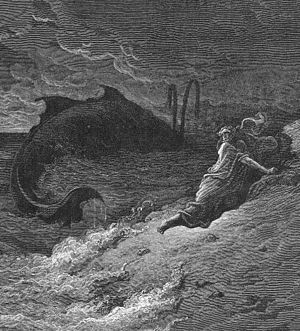
One attractive option is to treat Jonah as a Hebrew midrash. A midrash is a creative commentary on a text of Scripture. In other words, a midrash can be a story used to illustrate a text or lesson of Scripture. Those who make this argument point to Jonah 4:2:
[Jonah] prayed to the Lord and said, “Please Lord, was not this what I said while I was still in my own country? Therefore in order to forestall this I fled to Tarshish, for I knew that You are a gracious and compassionate God, slow to anger and abundant in lovingkindness, and one who relents concerning calamity.
Compare this verse to two others:
Exodus 34:6-7 - Then the Lord passed by in front of him and proclaimed, “The Lord, the Lord God, compassionate and gracious, slow to anger, and abounding in lovingkindness and truth; who keeps lovingkindness for thousands, who forgives iniquity, transgression and sin; yet He will by no means leave the guilty unpunished, visiting the iniquity of fathers on the children and on the grandchildren to the third and fourth generations.”
The similarity between Exodus 34:6-7 and Jonah 4:2 should be immediately obvious. Both describe God as compassionate and forgiving. So could the story of Jonah illustrate just how gracious God is? God is so loving He would even send a reluctant prophet to the Ninevites!
Consider also Jeremiah 18:7-8:
At one moment I might speak concerning a nation or concerning a kingdom to uproot, to pull down, or to destroy it; if that nation against which I have spoken turns from its evil, I will relent concerning the calamity I planned to bring on it.
Note here the theme of God relenting calamity on any nation that repents. That is exactly what Nineveh did. The language of Jonah 4:2 and Jeremiah 18:7-8 mirror each other. Therefore some see Jonah as a type of parable, or midrash, used to illustrates Jeremiah's point.
So is Jonah Midrash? I certainly think there is something to it. Here midrash could be confused or compared with a parable - a term we are more familiar with. Parable's were frequently used by Jesus an so long as we avoid some dangers, I think this might be a helpful interpretation. Certainly there is nothing new in Jonah, although the original readers were likely shocked by its content and implications.
But to say that Jonah is just another example of Hebrew midrash is over simplistic as we shall see.
For more:
Holman Dictionary on Jonah
Bibledex on Jonah
VeggieTales and Jonah
Wednesday, November 17, 2010
Holman Dictionary on Jonah
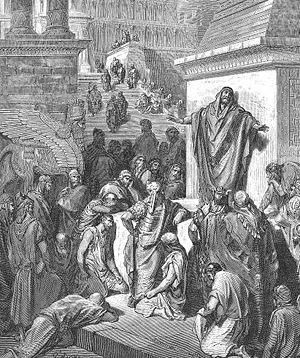
 . The entry on the book of Jonah is perhaps the best I came across covering the message of the book and the issues surrounding it in brief.
To begin, the editors note how many since the rise of modern liberalism and biblical criticism have enjoyed picking on Jonah arguing that it is simply a fable or a myth rejecting its historicity. The reasons for this should be obvious on the surface. For one, fish don't swallow people only to vomit them up again. Likewise, plants don't grow and then be eaten by a small worm in a matter of minutes or hours. The problem with such arguments is to assume that the God of creation has no control over His creation. If God is supernatural and not bound by natural laws, then it is logical to conclude that He can override natural laws in a supernatural way. Jonah is no exception.
The dictionary writes:
Many since the 19th Century AD have regarded Jonah as a parable or didactic fiction, as if factual history were ruled out by literary artistry or the recounting of miraculous events. If this narrative, however, whose form bears at every point the mark of a historical account, was judged unhistorical on either of these bases, then most of the Bible would follow easily along. It is pointless to ask whether Jonah really could have been swallowed by a great fish without also asking whether God really could communicate with a prophet. Every aspect of man’s encounter with God is miraculous. Jonah is clearly didactic, but it is not presented as fiction or interpreted as such by Jesus (cp. Matt. 12:40-41). -942
Also, the entry discusses why Jonah was so adamant to not preach repentance to the Ninehvites. This is helpful because oftentimes we read Jonah without realizing the difficulty of the task Jonah was asked to complete. Would we go to the inner circle of the most wicked terrorist and proclaim the gospel to them? I am willing to bet we wouldn't simply because we would think that they wouldn't deserve the good news.
Jonah was not pleased when God commanded him to go to Nineveh and preach repentance. The Assyrians worshiped the vicious god Ashur and a multitude of other gods and goddesses. Assyrian brutality and cruelty were legendary. The Assyrians were known to impale their enemies on stakes in front of their towns and hang their heads from trees in the king’s gardens. They also tortured their captives – men, women, or children – by hacking off noses, ears, or fingers, gouging out their eyes, or tearing off their lips and hands. They reportedly covered the city wall with the skins of their victims. Rebellious subjects would be massacred by the hundreds, sometimes burned at the stake. Then their skulls would be placed in great piles by the roadside as a warning to others. Jonah decided that he would rather quit the prophetic ministry than preach to such people. Nineveh was about 500 miles to the east, so he headed for Tarshish, probably what is now Spain, the farthest western location he knew, about 2,000 miles. -945
* The above picture is of Jonah preaching in Nineveh.
Bibledex on Jonah
Here is the video from the folks at Bibledex. I must say I am surprised that they don't come out and reject the historicity of the book. They in fact, almost ignore some of the modern criticism's of the book which is unlike them. So in that sense, this is perhaps my favorite they have done thus far.
They have also put together a second video with more footage from theologians talking about Jonah. Unlike the video above, one scholar emphasizes that Jonah is a satire. Although I agree there are satire in the story, I do not believe that the story itself is only satire. Just like Jesus used satire and humor in His ministry, so too the writer of Jonah offers a historical tale weaving in satire to make an even finer point. Here it is:
For more:
Bibledex on Malachi
Bibledex on Nahum
Bibledex on Habbakuk
Bibledex on Zephaniah
Bibledex on Zechariah
Bibledex on Malachi
Bibledex on Matthew
Bibledex on Mark
Bibledex on Luke
Bibledex on John
Bibledex on Romans
Bibledex on 2 Corinthians
Bibledex on Ephesians
Bibledex on Philippians
Bibledex on Colossians
Bibledex on 2 Thessalonians
They have also put together a second video with more footage from theologians talking about Jonah. Unlike the video above, one scholar emphasizes that Jonah is a satire. Although I agree there are satire in the story, I do not believe that the story itself is only satire. Just like Jesus used satire and humor in His ministry, so too the writer of Jonah offers a historical tale weaving in satire to make an even finer point. Here it is:
For more:
Bibledex on Malachi
Bibledex on Nahum
Bibledex on Habbakuk
Bibledex on Zephaniah
Bibledex on Zechariah
Bibledex on Malachi
Bibledex on Matthew
Bibledex on Mark
Bibledex on Luke
Bibledex on John
Bibledex on Romans
Bibledex on 2 Corinthians
Bibledex on Ephesians
Bibledex on Philippians
Bibledex on Colossians
Bibledex on 2 Thessalonians
Veggie Tales and Jonah
I found this hilarious. Tonight we'll be studying the book of Jonah and the folks over at Veggie Tales have an entire movie dedicated to the prophet's story. What follows is the blooper real from the movie put together by the makers. I also recommend watching the movie especially if you have kids. Its pretty good and covers the entire story.
If you would like to watch the entire movie online for free, click here. I am unable to embed the video, but it is through youtube. And to top it all off, here is a music video from one of my favorite bands, Newsboys, called "In the Belly of the Whale" that was on the soundrack for the movie:
If you would like to watch the entire movie online for free, click here. I am unable to embed the video, but it is through youtube. And to top it all off, here is a music video from one of my favorite bands, Newsboys, called "In the Belly of the Whale" that was on the soundrack for the movie:
Subscribe to:
Posts (Atom)


 Posts
Posts

