I've been thinking a lot about blood lately. I've been preaching through the Gospel of Matthew in recent weeks and we are at a major turning point. The confession of Peter at Caesarea Philippi changes the narrative drastically. No longer is the story about life, vibrancy, and public miracles. Instead, its about suffering, judgment, wrath, a public death, and blood. Blood. The Bible is, to say the least, a very bloody book. Not just because it is full of tales with murder and war, but God is a God that requires a lot of it.
It is this thought that moved me to the wonderful book Precious Blood: The Atonement of Christ edited by Richard D. Phillips with contributing chapters by Philip Ryken, Carl Truman, RC Sproul, Joel Beeke, and several others. The book is basically broken up into two parts: biblical/systematic theology and historical theology.
The book begins looking at the biblical/systematic theological truth of the atonement. Why is the cross necessary? The contributers walk the reader through what Scripture says and why penal substitution is the root meaning of the cross. The first chapter is fascinating. Written by Beeke, the author looks at the Passover and relates it to Christ. The parallels between the lamb in Exodus and the Lamb in the Gospels is striking and Beeke draws some conclusions that I had not seen before. Likewise, the chapter looking at the atoning work of the cross is helpful. Walking the reader through the images of the temple (propitiation), the market (redemption), and the courtroom (justification) is a helpful way to understand the precious blood of Jesus Christ.
The section on historical theology is pretty straightforward. There's a chapter on the early church and their soteriology, on medieval theology, the Reformers (of course!), the puritans, etc. The two most helpful chapters here are the ones on the theology of the Early Church and on the more contemporary issue of responding to those in the non-violent atonement camp.
Regarding the Early Church, the contributor slowly guides the reader through the complications of asking what the early church believed on this issue. We must remember, the author notes, that the early church, though wrote theology, were as much apologists for the gospel. They were having to fight off Gnosticism, Marcionism, docetism, all the while running for their lives from various persecutions. But that does not mean that nothing is said on the subject. The author lays out the case in their belief in the recapitulation theory, the ransom theory, and even penal substitution.
But the most helpful chapter to me personally was the last chapter which was a response to the critics of penal substitution. It is increasingly popular in evangelicalism today to write off penal substitution as a form of "divine child abuse." The chapter walks the reader through what has been said on the subject and how a right view of God, man, Christ, and the cross - as the Bible presents it - demands a correct understanding of penal substitution without all of the unnecessary rhetoric. The author makes an excellent point here. All of the talk about being open to other views on the atonement, and the author agrees that there is something to Christus Victor and others, this is all really an effort to undermine penal substitution. It is, if you will, a "anything but propitiation," campaign that has gained a lot of traction.
Overall this is an excellent book on an important subject that you need in your library. The gospel is under assault and books like this will contribute to the recovery of the gospel. I conclude with the books conclusion:
But what about the culture? Is it true that our postmodern world does not register with the legal considerations of penal substitutionary atonement? If this is so, might it be that the world so little knows the truth about God and that our culture has, in its sensual addictions, as Paul puts it, suppressed the truth of God in unrighteousness and 'exchanged the truth about God for a lie' (Rom. 1:18, 25)? If this is the case, and an assessment of postmodern culture based on a belief in the authority and truth of Scripture is bound to reach such a conclusion, then for Christians to collaborate in so deadly a deception will neither advance the true cause of the gospel nor reflect the merciful love of God towards the world.
But is it really true that the biblical gospel of Christ's atoning death as our penal substitute cannot hope to reach today's world? Once we see that the gospel reveals not another warmed-over version of failed humanistic thinking but, rather, a rejection of Western individualism for a saving, covenantal solidarity with God's own Son, who loved us enough even to take our sins t the cross, then perhaps Williams is right when he suggests that, contrary to its critics, 'penal substitution has a bright future and will preach well.' -225
It has been said that Christianity is a bloody religion. critics
usually make this accusation, pointing to the wars, inquisitions,
trials, and executions carried out over the years in the name of
Christianity. We must admit that blood has been wrongly shed in the name
of so-called Christianity, but Christianity would be a bloody religion
regardless. it is a blood religion not because o the blood shed by
people in wars and inquisitions, but because of the blood shed by Jesus
Christ. (1)
To read the Bible with any
seriousness and sober discernment is to see the shedding of blood or the
implications of it on practically every page. If the history of
redemption is a story told in pictures, the blood of Christ is the paint
with which the story is portrayed. (2-3)
The Bible is a bloody book. One can barely turn a page of Scripture without seeing its distinct stain on the page. From the sacrifice of an innocent animal to cover the nudity of Adam and Eve, to the murder of Abel, to the Day of Atonement, to the countless murders, wars, and rapes, to the cross itself, to the martyrdom of the first saints, and even in the end when Christ returns with a sword. There is an over-abundance of blood throughout Scripture.
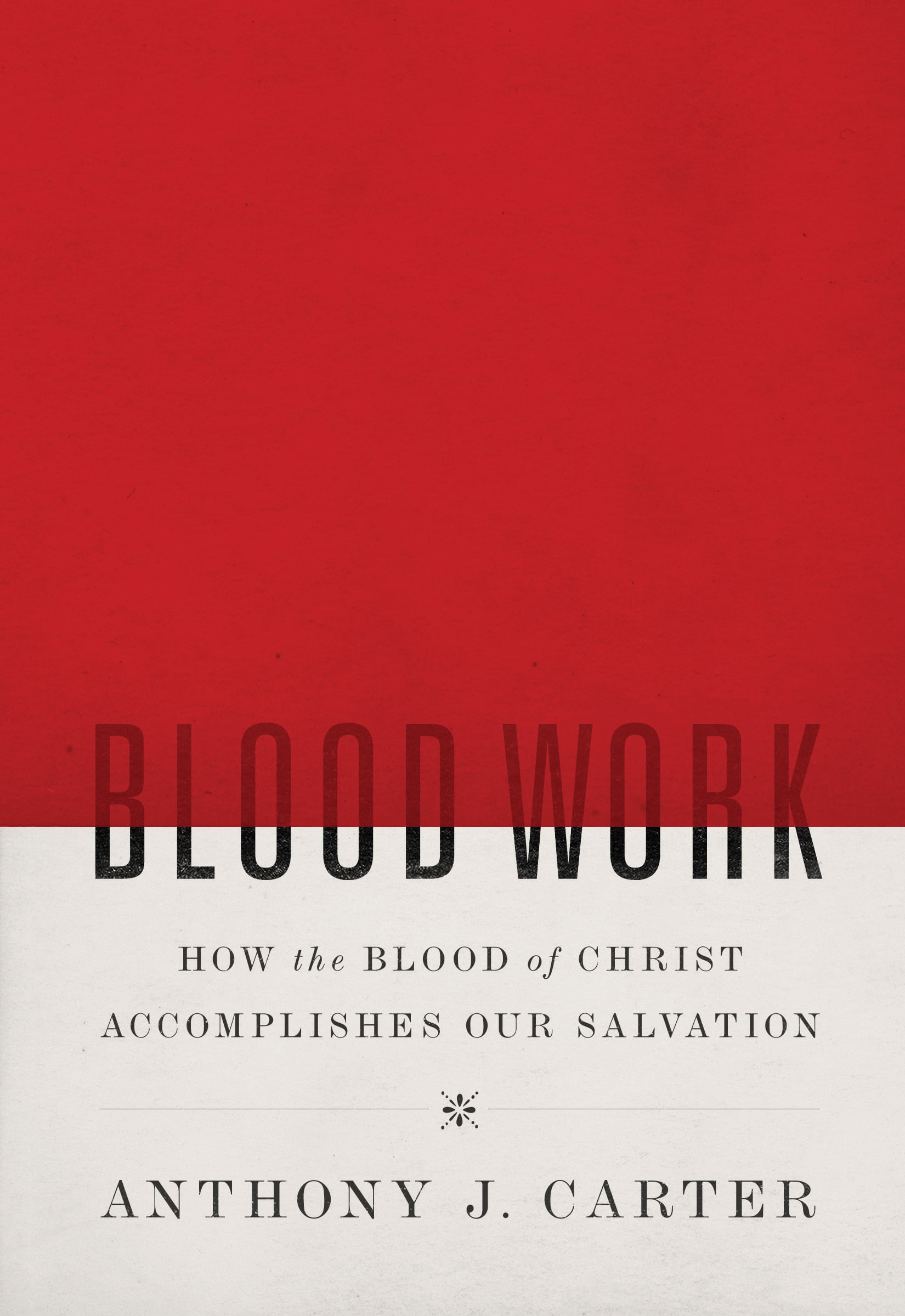
The good news of Jesus Christ by which men are saved, the church is established, the Kingdom is inaugurated, and the cosmos retaken itself is a bloody gospel. To many such a theme is confusing and strange especially in the 21st century. In his book Blood Work: How the Blood of Christ Accoplishesh Our Salvation (Reformation Trust, 2013), Anthony Carter delves into the theme of blood and how it assures our propitiation, salvation, justification, reconciliation, ransom, redemption, cleansing, sanctification, peace, and every major soteriological theme in Scripture.
I picked up this book simply because I have become convinced that missing from Christianity is an emphasis on blood. As the author illustrates throughout the book, the great hymns of old were filled with blood. "What can wash away my sin," the hymn writer asks. "Nothing but the blood of Jesus." Another reminds us "There is a fountain filled with blood drawn from Immanuel's veins." A fountain full? What happened to the blood.*
Perhaps the greatest benefit of Carter's book is it clear reminder that one cannot speak of grace or salvation without an emphasis on blood. The blood of goats are not enough, the writer of Hebrews tells us, and cannot save. Instead what we need is the penal substitutionary blood of the Lamb of God.
The outline of the book is simple. Each chapter looks at a major theme of soteriology and shows how blood defines it. So perhaps we could sum up the contents of the book as follows:
Blood purchases us
Blood Propitiates the Wrath of God
Blood justifies us
Blood brings us near to God
Blood makes peace
Blood cleanses us
Blood sanctifies us
Blood elects us
Blood ransoms us
Blood frees us
A couple of thoughts. First, the theology is sound and Reformed. As the above outline shows, there is an entire chapter dedicated to the subject of election and the author makes reference and develops it throughout the book. Beyond the question of predestination (and I am reformed myself), defends orthodox soteriology and though the language of blood might be strange for us today, this book would not have been so unique in the past. What I find helpful about Carter's approach to this subject is it reminds us that Scripture utilizes a number of images and ideas to describe and define salvation. Redemption reminds us of our slavery to sin. Justification reminds us of our guilt before God. Cleansing reminds us of the filthy nature of sin. We should not be surprised, then, that blood covers them all.
Secondly, this is not an academic book. Carter is not interested in old debates over the nature of Scripture, various theologies of salvation (liberation theology, liberalism, the social gospel, etc.), or atonement theories (moral influence, Christus Victor, etc.). Carter seeks to explain what role blood plays and how it accomplishes our salvation as revealed in Scripture. An academic book typically finds itself in debating both debates of the past and debates of the present. Carter avoids this. This is neither a praise nor criticism of the book, but a confession as to what sort of book this is. This also means that Blood Work is accessible to the average Christian.
Thirdly, the writer is good but it is not great. This brings with it the benefit of it being more accessible to the average Christian new to theology and the theme of blood, but at times the writing is almost too simple. I do not want to suggest, however, that there are no memorable quotes or powerful paragraphs. Consider the following.
Regarding sin:
How do we know that someone understands the blood of
Christ in his life? We know it by the fact that he or she is not out for
revenge, but is living out redemption. 10
The human condition is not just a bucket of errors; it is an ocean of iniquity. 34
Thus, it is important to see that the Bible portrays sin not just as an action but also as a tyrannical master. 43
The tragedy of sin is not just that it kills, but that it defiles, it
violates, and it dirties our consciences, our hands, and our lives
beyond our ability to clean them. 71
Regarding the blood of Christ:
The blood of Christ gives us a home. The blood of Christ becomes the
flag and color under which we stand. The blood of Christ takes those who
were once strangers and makes them family. As the Bible says, we are
“no longer strangers and aliens, but . . . fellow citizens with the
saints and members of the household of God (Eph. 2:19). Simply put, the
blood of Christ brings us near to God. As Stott reminds us:
And this nearness to God which all Christians enjoy through Christ is a privilege we take too frequently for granted. Our God does not keep his distance or stand on his dignity, like some foreign potentate, nor does he insist on any complicated ritual or protocol. On the contrary, through Jesus Christ and by the Holy Spirit we have immediate “access” to him as our Father. We need to exhort one another to avail ourselves of this privilege. (40)
Regarding the blood of Jesus and reconciliation:
The blood of Jesus tears down the walls of hostility and brings peace
and prosperity of soul. It takes a people who are not His people and
makes them His people under God, indivisible. The blood of Christ,
spilled at the cross, is so powerful that it destroys all the foolish,
oxymoronic statements we sometimes hear: “selfish Christian”—there is no
self at the cross, only Jesus; “stingy Christian”—the cross is the
greatest motivation for giving there could ever be; “proud
Christian”—the ground at the foot of the cross is the humblest in the
history of the world; or “racist Christian”—at the cross there is no Jew
or Gentile, black or white, Arab or Asian. There is only Christ and
those who are washed in His blood.
In Christ, the ethnic and racial identities that separate and often become the source of animosity and even enmity lose their power to divide. The blood of Christ overcomes them. There- fore, Christians must remember that there is only one family of God. We not only fly the same flag and fight under the same banner, but we share the same blood. That blood has brought us near—to God and each other. Racial and ethnic bloodlines are not omnipotent. The blood of Christ is.When the blood of Christ brings us near, it brings us to the cross and asks us this question: “Do you remember?” Let us remember that the blood of Christ has reconciled us to God, ended the hostility, and transformed us from enemies to friends. Let us remember to pray as the songwriter suggests:Lest I forget Gethsemane, Lest I forget thine agony, Lest I forget thy love for me, Lead me to Calvary. (57-58)
Consider also some of the following helpful illustrations. First a story about Augustine:
The story is told that Augustine, the fourth-century theologian and
bishop of Hippo in North Africa, after confessing faith in Jesus Christ,
ran into a former mistress on the street. Immediately upon recognizing
her, Augustine reversed his course and began moving swiftly in the
opposite direction. The woman, surprised at seeing Augustine and
equally surprised at the reversal of his route, cried out, “Augustine,
it is I.” Augustine, continuing to move away from her, replied, “Yes,
but it is not I.” (79)
Secondly a legend about Abraham Lincoln:
The story is told that Abraham
Lincoln went down to the slave block and there noticed a young black
girl up for auction. Moved with compassion, he bid on her and won. Upon
purchasing her, Lincoln told the disbelieving girl that she was free.
In her surprise, she said, “What does that mean?” “It means you are free,” he replied. “Does that mean,” she asked, “I can say whatever I want to say?” “Yes, my dear, you can say whatever you want to say.” “Does that mean I can be whatever I want to be?” “Yes, you can be whatever you want to be.” “Does that mean I can go wherever I want to go?” “Yes, you can go wherever you want to go.” At that, the girl, with tears streaming down her face, said, “Then I will go with you.” Admittedly,
this account is probably more legendary than legitimate. Yet it does
communicate an important spiritual truth. Like the young girl on the
slave block, we, too, have been redeemed and set free. The Bible reminds
us in 1 Peter 1:18–19 that if we are in Christ, we have been “ransomed
from the futile ways inherited from [our] forefathers, not with
perishable things such as silver or gold, but with the precious blood of
Christ.” The blood of Christ is of incalculable value, and for that
reason it alone is able to ransom sinners from their slavery to sin.
(99-100)
More could be given, but this should make the point. Carter is not a great writer, but is a memorable one. Then again, when one proclaims the wonderful gospel, how can we not be? Carter wants the reader to not just have his head filled with a better understanding of the biblical theme of blood and the role it plays in our salvation, but to instead use this great theology to bring us to praise. It is not an accident that the great hymns and praise songs quoted throughout the book are used. If this is true regarding the blood of Jesus, and it is, then how can we not worship.
O precious is that flow That makes me white as snow. No other fount I know Nothing but the blood of Jesus
* The author provides an entire appendix of his book to songs on the subject of blood.
Reformation Trust was kind enough to provide a free copy of this book for the purpose of this review.





 Posts
Posts

